

Generative Engine Optimization (GEO) is the process of structuring content so AI systems like ChatGPT, Perplexity, Claude, and Gemini can extract, understand, and cite it in generated answers. Implementing GEO means more than writing better articles. It means organizing topics into connected clusters, structuring every page for extraction, reinforcing your brand as a consistent entity, and measuring whether AI systems are actually citing you. This guide walks through each step in order, from foundational setup to ongoing measurement.
What GEO Implementation Actually Involves
GEO implementation is not a single content optimization task. It is a system built across four layers that work together to make your brand consistently citable by AI systems.
The Four Layers of GEO Implementation:
- Content structure: Every page answers its primary question directly, organizes information into extractable blocks, and uses headings that map to real queries.
- Topical authority: Related articles are grouped into content clusters with a pillar article at the center and supporting articles covering specific subtopics.
- Entity clarity: Your brand name, product names, and core topic associations are used consistently across every page and every external mention.
- Measurement: You track which queries your brand appears in, how it is described, and where competitors are being cited instead of you.
Most brands start GEO by optimizing a single article. That is a reasonable place to begin, but it is not a complete implementation. All four layers need to be in place before you can expect consistent, compound citation results.
Step 1: Define Your Core Topic and Entity
Before writing or restructuring a single piece of content, clarify two things: the topic you want to be known for, and the entity that should be associated with it.
Topic: The subject area your brand publishes on and wants AI systems to cite it for. This should be specific enough to own, not broad enough to describe an entire industry.
Entity: The brand name, product name, or person that AI systems should recognize and associate with that topic. Entity clarity means AI systems can accurately describe who you are and what you do when they cite you.
Example:
- Topic: AI visibility and generative engine optimization
- Entity: AuthorityStack.ai
- Association: "AI visibility tracking platform that measures how often brands appear in AI-generated answers"
The rule: One core topic per entity, at least to start. A brand that publishes consistently on a focused subject builds a stronger entity-topic association than one that covers many unrelated subjects. Define this association clearly before you write anything, because it shapes every content decision that follows.
Step 2: Build a Content Cluster, Not Just One Article
GEO does not work with isolated content. A single article, even a well-structured one, is a single data point. AI systems build topical authority at the domain level, not the page level. To be consistently cited across a subject, you need a cluster of related articles that collectively cover the topic from multiple angles.
Content cluster structure:
A content cluster consists of one pillar article and five to eight supporting articles.
- Pillar article: A comprehensive reference that covers the topic broadly, defines key concepts, and links out to every supporting article. This is the page AI systems cite for broad queries like "what is GEO" or "how does generative engine optimization work."
- Supporting articles: Each one goes deep on a specific subtopic, use case, question, or angle introduced in the pillar. These are the pages AI systems cite for specific queries like "GEO mistakes to avoid" or "how to structure content for AI citation."
Example cluster for GEO:
| Article | Type | Primary query it answers |
|---|---|---|
| What Is Generative Engine Optimization? | Pillar | What is GEO? |
| GEO vs SEO: What Is Different | Supporting | How does GEO differ from SEO? |
| How AI Systems Choose Sources | Supporting | How do AI systems decide what to cite? |
| GEO Mistakes to Avoid | Supporting | What are the most common GEO mistakes? |
| How to Structure AI-Citable Content | Supporting | How do I structure content for AI extraction? |
| How to Measure AI Visibility | Supporting | How do I know if GEO is working? |
Publish the pillar first, then supporting articles over the following four to eight weeks. Each supporting article links back to the pillar and to at least two sibling articles using descriptive anchor text.
Step 3: Use Answer-First Content Structure
Every page in your cluster must open with a direct answer to its primary question. This is the single most important structural change you can make, and it applies to every article, every section, and every FAQ answer.
AI retrieval systems scan page openings first. A page that answers its primary question in the first two to four sentences is significantly more likely to be cited than one that builds toward the answer over several paragraphs.
The format:
Sentence 1: Definition or direct answer to the primary question
Sentence 2: How it works or supporting context
Sentence 3: Why it matters or who it applies to
Example:
Bad opening: "In today's rapidly evolving digital landscape, businesses are starting to pay attention to how AI systems interact with their content. This has led to the emergence of a new discipline that many marketers are now exploring..."
Better opening: "Generative Engine Optimization (GEO) is the process of structuring content so AI systems can extract and cite it in generated answers. It works by organizing information into direct answer blocks, self-contained sections, and structured formats that AI retrieval systems can pull from accurately. For any brand that wants to appear in AI-generated answers, GEO is the discipline that makes that possible."
The better version answers the question immediately, explains the mechanism, and states the relevance. A reader or AI system scanning the first three sentences gets everything they need to understand the topic.
Step 4: Make Every Section Self-Contained
AI systems frequently cite individual sections of articles rather than whole pages. This means every H2 section needs to be fully understandable in isolation, without requiring the reader to have read earlier sections.
A section that opens with "As we discussed in the previous section" or that uses a term defined three sections back cannot be cleanly extracted. The citation either fails or produces an inaccurate answer.
Rules for self-contained sections:
- Open each section with a sentence that states what the section covers, without assuming prior context
- Define any term used in the section that was not defined within that section
- State the key claim before elaborating on it, not after
- Do not reference earlier sections or forward-reference later ones
- Close with a summary sentence or key takeaways list
The extraction test: Cover the rest of the article and read only one section. If a reader who has never seen the rest of the page can understand it fully and accurately, the section passes. If they would need earlier context to make sense of it, rewrite the opening.
Step 5: Add Citation Target Blocks to Every Section
A citation target block is a sentence or short passage within a section that is specific enough to be extracted and cited on its own. Most content has the right information but buries it in prose that AI systems cannot cleanly pull from. The fix is not rewriting the substance. It is surfacing the key claim in a format AI systems can identify and extract.
Every major section should include:
- A direct answer sentence that states the section's core claim clearly
- An explanation of the mechanism (how or why it works)
- An example or concrete illustration
- One quotable sentence that could stand alone as a complete answer
Example of a citation target block:
"Long paragraphs reduce AI extractability because multiple ideas are grouped into a single block that retrieval systems cannot separate cleanly. AI systems extract content more accurately when each paragraph contains a single, clearly defined idea in two to four sentences."
That two-sentence block names the problem, explains the mechanism, and states the correct approach. It can be pulled out and cited accurately without any surrounding context.
Key takeaways from this section:
- Citation target blocks are the sentences AI systems actually extract and repeat
- Every major section needs at least one sentence specific enough to stand alone as a quoted answer
- The mechanism and the outcome both need to be named, not just asserted
Step 6: Define Key Terms Explicitly
Every important concept, term, or named framework must be defined on first mention using a clear, standalone definition. AI systems build their understanding of a topic by aggregating definitions from across the web. A brand that consistently publishes clear, accurate definitions of its core terminology becomes a source AI systems return to for those definitions.
Definition format:
Bold the term, follow with a colon, then a one to two sentence definition that makes complete sense without surrounding context.
Examples:
Topical authority: The degree to which AI systems and search engines consistently associate a brand with a specific subject area, based on the depth and coherence of its published content on that topic.
Content cluster: A set of related articles organized around a central pillar article, where each supporting article covers a specific subtopic in depth and links back to the pillar.
Entity signal: A consistent, repeated reference to a brand, product, or concept that helps AI systems build an accurate model of what that entity is and what it is associated with.
After defining a term on first mention, alternate between the full term and its acronym naturally throughout the article rather than collapsing entirely into the acronym. This reinforces the entity association and improves citability for both the full phrase and the shortened form.
Step 7: Use Structured Content Formats Throughout
AI systems are pattern-matching across large volumes of content. A labeled, structured format signals the type of information it contains and makes extraction more accurate than the same information in flowing prose.
Use numbered lists for: Sequential steps, processes, and ordered instructions where the sequence matters.
Use bullet lists for: Non-sequential key points, features, and items where order does not matter.
Use comparison tables for: Distinguishing between two or more options across multiple attributes. Any time you find yourself writing a sentence containing "whereas," "unlike," or "in contrast," that sentence is a signal to use a table instead.
Use definition blocks for: Introducing key terms and named concepts, formatted with a bold label and a one to two sentence standalone definition.
What to avoid: Pure long-form prose with no structured formatting. Mixed ideas within a single paragraph. Comparisons written as narrative rather than as a table or parallel list.
The goal is to make content machine-extractable. Each structural block should be identifiable at a glance as a specific type of information.
Step 8: Optimize Headings for Real Queries
Every H2 and H3 heading should reflect a specific query a user would actually type into ChatGPT or Perplexity. Question-format headings are the default for all informational content. They map directly to retrieval patterns and increase the likelihood that a section is pulled for the query that matches its heading.
Use question headings:
- "What Is Generative Engine Optimization?"
- "How Does GEO Differ from Traditional SEO?"
- "How Do AI Systems Choose What Content to Cite?"
- "Why Does Internal Linking Matter for GEO?"
Use noun-phrase headings only for named frameworks and concepts:
- "The Four Layers of GEO Implementation"
- "The GEO Content Cluster Framework"
Never use:
- "Introduction"
- "Overview"
- "Key Points"
- "Background"
- "More About This"
These headings tell AI retrieval systems nothing about what the section covers and should not appear anywhere in GEO-optimized content.
Step 9: Build Internal Links Across the Cluster
Internal linking is how the content cluster signals its structure to AI retrieval systems. When articles link to each other with descriptive anchor text, AI systems can map the relationships between them and build a stronger model of the source domain's expertise on the subject.
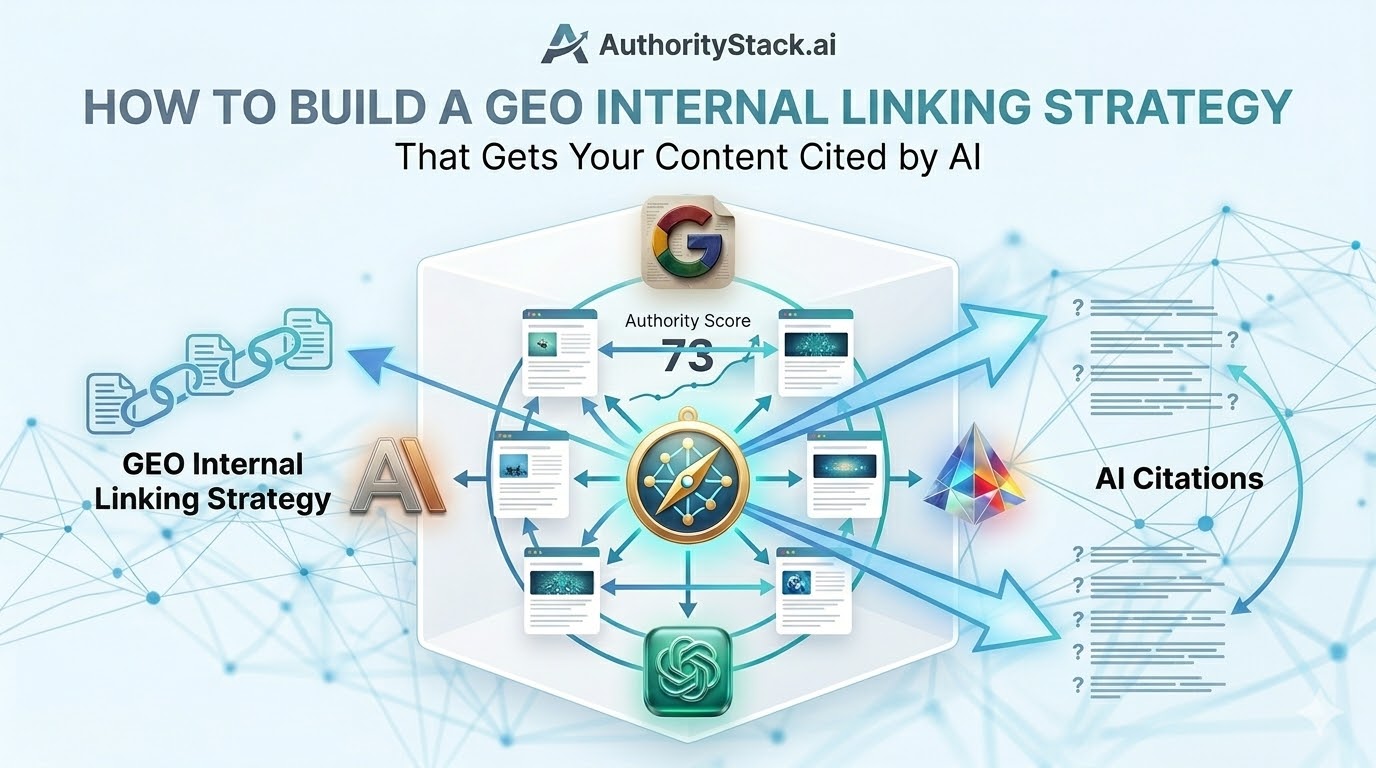
The linking pattern for every article in the cluster:
- Every supporting article links to the pillar article contextually, within the body text
- Every supporting article links to at least two sibling articles at points where their topics naturally intersect
- The pillar article links to every supporting article at the point where each subtopic is introduced
- Every new article published gets linked from the pillar and from at least two relevant sibling articles on the day it goes live
Anchor text rules:
Anchor text must describe the subject of the destination page clearly enough that someone who has never seen it would understand what it covers.
Bad anchor text: "click here," "read more," "this article," "our guide"
Good anchor text: "how to structure content for AI citation," "measuring your brand's AI citation share," "GEO mistakes to avoid"
Good anchor text is what allows AI retrieval systems to infer the relationship between two pages without following the link.
Step 10: Add a Standalone FAQ Section
A well-structured FAQ section is one of the highest-yield GEO investments in any article. FAQ sections are structurally identical to how users phrase queries to AI systems, a question followed by a direct answer, which means each question-answer pair is already formatted for AI retrieval.
Rules for GEO-ready FAQ sections:
- Include four to eight questions minimum
- Write every question in natural language, as a user would type it into ChatGPT or Perplexity
- Every answer must be fully self-contained: a reader who sees only the question and answer should receive a complete, accurate response with no surrounding context needed
- Every answer must start with a direct response to the question, not with a reference to the article
- Include at least one specific fact, number, or named reference in each answer
Example:
Bad FAQ answer: "As we discussed earlier in this guide, GEO works by structuring your content in specific ways that help AI systems understand it better."
Better FAQ answer: "GEO works by organizing content into direct answer blocks, definition sections, numbered step sequences, and self-contained H2 sections that AI systems can extract and cite accurately. It does not require technical changes to a website. The primary work is editorial: how content is structured and how clearly it answers specific questions."
The better answer starts with the mechanism, explains the approach, and dispels a common misconception, all without referencing anything else in the article.
Step 11: Set Up the Technical Foundation
The technical layer of GEO is a support structure, not the primary driver. Content structure and clarity account for roughly 70% of what determines AI citation rates. Schema markup, canonical hygiene, and indexing settings account for the remaining 30%, and mostly as a baseline that allows the content work to function correctly.
Schema markup to implement:
- Article or BlogPosting schema on all editorial content
- FAQPage schema on any page with a FAQ section
- HowTo schema on step-by-step instructional content
- BreadcrumbList schema reflecting the page's position in the site hierarchy
Technical hygiene checklist:
- Canonical URL for each page is set correctly and points to the intended version
- No duplicate pages are competing for the same query
- Pages intended for citation are properly indexed and not tagged with a noindex directive
- Page load times are reasonable: slow pages are deprioritized by some AI retrieval systems
Fix content structure first. Add schema and resolve technical issues after the content passes the AI extraction test. Schema applied to poorly structured content does not compensate for the structural problems.
Step 12: Measure Your AI Citation Share
Without measurement, GEO is guesswork. You need to know whether AI systems are citing your content, how they are describing your brand, and where competitors are appearing in answers instead of you. That data is what turns GEO from a publishing exercise into an improvable strategy.
What to measure:
- Are you cited in AI-generated answers for your target queries?
- How is your brand described when it is cited?
- Which competitors appear for queries where you do not?
- Which content changes correlate with citation improvements over time?
How to build a measurement routine:
- List the ten to twenty queries your brand should appear in based on your topic and entity definitions from Step 1
- Run those queries across ChatGPT, Perplexity, Claude, and Gemini
- Document whether your brand appears, how it is described, and which competitors appear instead
- Repeat after publishing new content or restructuring existing articles to track changes
- Identify coverage gaps where competitors are consistently cited and you are not, and prioritize those as your next content targets
For systematic monitoring across many queries and platforms, AuthorityStack.ai tracks your brand's citation share across ChatGPT, Claude, Gemini, and Perplexity automatically, showing you which content is earning citations, how your brand is described, and where gaps exist.
GEO Implementation Checklist
Use this checklist before publishing any article and when auditing existing content.
Content
- Answer-first opening: the first two to four sentences directly answer the primary query
- Every major section passes the self-containment test
- At least one citation target block per section: a sentence specific enough to stand alone as a quoted answer
- Key terms defined on first mention using bold-term-colon format
- No unresolved pronouns: "this," "that," and "it" always name their subject explicitly
Structure
- Question-format headings for all informational sections
- No generic headings: "Introduction," "Overview," "Key Points" do not appear
- Numbered steps for processes, bullet lists for key points, tables for comparisons, definition blocks for terms
- Paragraphs of two to four sentences, one idea each
- Sections of 80 to 200 words, or broken into H3 subsections of that length
Authority
- Content is part of a defined cluster, not an isolated article
- Article links to the pillar and to at least two sibling articles
- Anchor text describes the subject of the destination page, not generic phrases
- Brand name and product names are used consistently throughout
Technical
- Article, FAQPage, or HowTo schema applied as appropriate
- Canonical URL is correct
- Page is indexed and not accidentally noindexed
Measurement
- Target queries defined for this article and the cluster
- Baseline citation check completed before publishing
- Scheduled follow-up check after the article has been live for four to six weeks
FAQ
What is GEO implementation?
GEO implementation is the process of structuring content, organizing topic clusters, and building entity signals so that AI systems like ChatGPT, Perplexity, Claude, and Gemini can extract and cite your brand accurately. It involves twelve steps covering content structure, topical authority, entity consistency, and measurement. GEO implementation is not a one-time content optimization. It is a system built and maintained across multiple articles and platforms.
How long does GEO implementation take to produce results?
There is no fixed timeline. AI systems update their retrieval behaviors at different intervals, and the path from publishing to citation is not as predictable as traditional search ranking. That said, well-structured content from an established domain can begin appearing in AI-generated answers within weeks of publication. A full content cluster, published over four to eight weeks and linked correctly, typically produces compounding citation results over a period of two to four months.
Do I need technical skills to implement GEO?
No. GEO is primarily an editorial discipline. The most impactful steps, writing direct answer openings, structuring self-contained sections, adding definition blocks, and building content clusters, require no technical skills. The technical layer, schema markup and canonical hygiene, is the smallest driver of GEO results and can be handled by a developer separately after the content work is done.
Should I start with new content or optimize existing content?
Both approaches work, and the right choice depends on what you have. If you have existing high-traffic articles on your core topic, retrofit them first. Rewriting the opening paragraph, adding definition blocks, converting process explanations to numbered steps, and adding a FAQ section can significantly improve the citation potential of existing content without a full rewrite. If your existing content is thin or off-topic, start fresh with a properly structured pillar article and build the cluster from there.
What is the most important step in GEO implementation?
Answer-first content structure is the single most important step. AI retrieval systems scan page openings first. A page that answers its primary question in the first two to four sentences is significantly more likely to be cited than one that delays the answer. If you can only implement one change, rewrite your opening paragraphs to lead with the direct answer before any background or context.
How do I know if my GEO implementation is working?
The direct way is to query AI platforms with your target questions and check whether your brand appears in the generated answers. For systematic tracking, AuthorityStack.ai monitors your brand's citation share across ChatGPT, Claude, Gemini, and Perplexity, showing which content is being cited, how your brand is described, and where competitors are capturing citations instead of you. Without monitoring, you have no reliable signal of whether your GEO efforts are producing results.
Comments
All comments are reviewed before appearing.
Leave a comment